Desert Eagle Drilling: from one homepage to a site that sorts every search.
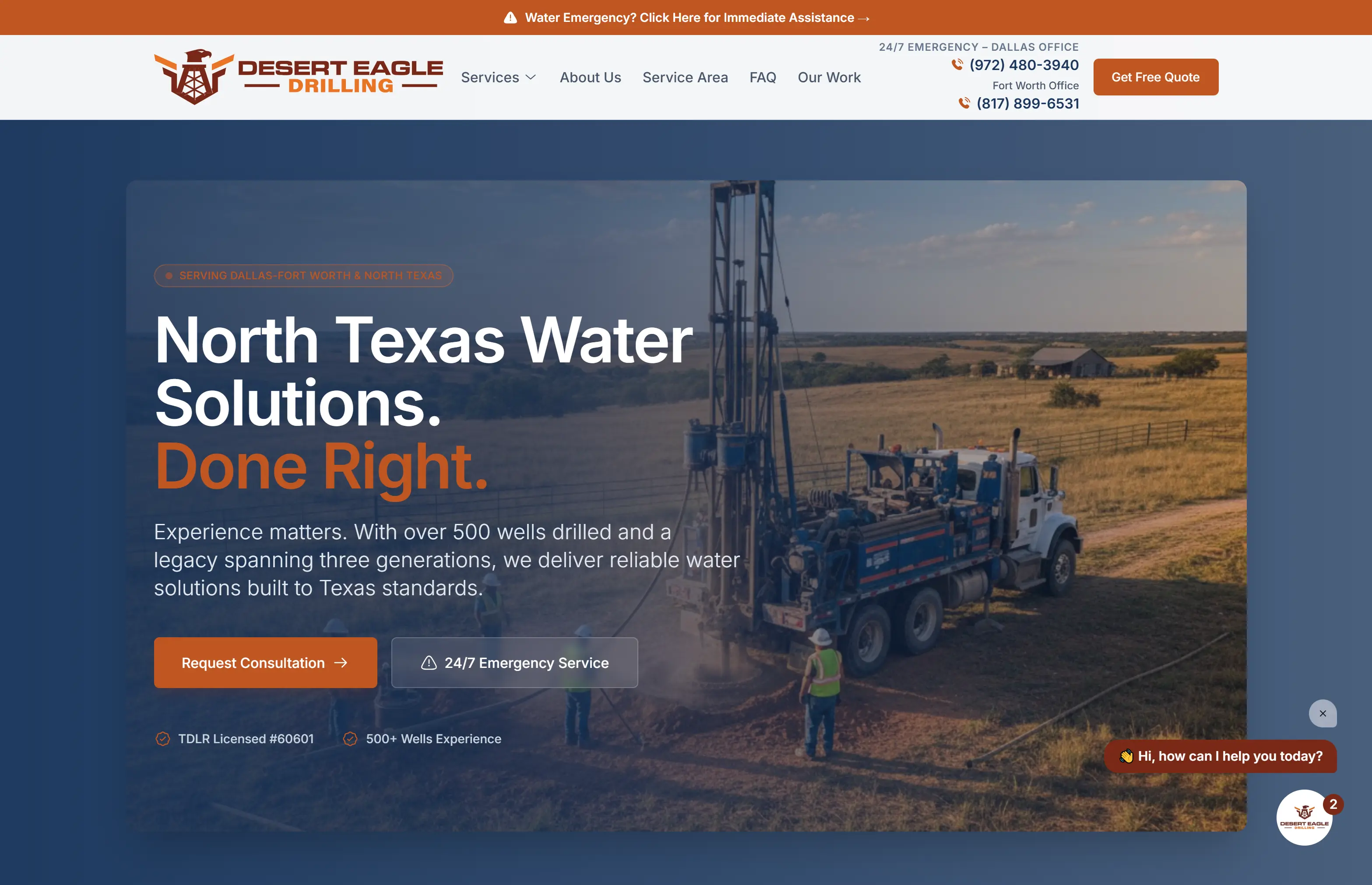
A North Texas well driller with a 24/7 emergency line and a single page to explain it all. I split the site into the jobs people actually search for, built a page for every county they drill in, and made sure calls from ads get counted.
- Client
- Desert Eagle Drilling, Dallas–Fort Worth
- Trade
- New wells, pump repair, 24/7 emergency, testing
- My role
- Website, technical SEO, call & form tracking
- Timeline
- June – October 2026
quote requests for new wells in 30 days, the company's biggest job
indexable pages, up from a single homepage
county pages with real local well facts
technical fixes on the homepage alone
Quote requests counted from the quote form's submission log, 22 Sep – 22 Oct 2026. Two further entries were sales pitches and aren't counted.
Good drillers. One page doing every job.
Desert Eagle drills new wells and fixes old ones across North Texas. The crew is licensed and there's a 24/7 emergency line. The website didn't show any of that clearly.
- One homepage tried to cover everything. Someone with no water at 7 PM landed on the same page as someone planning a new well.
- The company sells 24/7 emergency service, but there was no page built for emergencies.
- 21 unused font stylesheets loaded on every visit, and dead links sat in the footer.
- No sitemap or robots.txt, so Google had little help finding the site's pages.
- Calls tapped on a phone after clicking an ad weren't being counted, and nearly all paid leads came from phones.
A page for each job people search for.
Someone searching “no water from well” now lands on the emergency page, not a general homepage. Each page answers that customer's questions and ends with the right next step.
Emergency well service
The 8 most common well emergencies, what to do before the tech arrives, and a 10-question FAQ. Tap-to-call everywhere.
Well & pump repair
Pumps, pressure tanks, switches and controls, with repair-vs-replace guidance so homeowners know what to expect.
Maintenance & testing
Inspections, flow checks and water testing, a testing schedule, an 11-question FAQ and a “Schedule an inspection” button.
The new site structure
Homepage  ─ services, story, team, FAQ, work, quote form
├── Emergency well service
├── Well & pump repair
├── Maintenance & testing
├── Service area hub
│   └── 9 county pages
└── Thank-you page  (after a quote is sent)
9 county pages that say something real.
Swapping the county name on a template doesn't help anyone, and Google treats those pages as thin. Each page covers what's under the ground there: the aquifer, how deep wells usually go, the groundwater district, water quality, local problems like the 2021 freeze, and county-specific FAQs.
| County | Main aquifer | Typical depth |
|---|---|---|
| Jack | Antlers; Twin Mountains / Paluxy in places | 100–500 ft |
| Wise | Antlers; Paluxy, Glen Rose, Twin Mountains | 150–600 ft |
| Parker | Twin Mountains (west), Paluxy (east) | 150–600 ft |
| Hood | Twin Mountains | 200–700 ft |
| Johnson | Twin Mountains – Travis Peak | 400–900+ ft |
| Denton | Paluxy (west), Twin Mountains (east) | 300–1,000+ ft |
| Collin | Downdip Trinity; Woodbine in places | 500–1,200+ ft |
| Grayson | Antlers (west), Woodbine (east) | 200–900+ ft |
| Cooke | Antlers | 150–500 ft |
Calls first, and every call counted.
Most well customers call rather than fill in a form, and in June 2026 every tracked paid lead came from a phone. So calling is one tap from anywhere on the site.
- A “Water emergency? Tap to call 24/7” bar at the top of every page, plus both office numbers in the header.
- Google call tracking on all 16 pages, so calls from ad visitors count as conversions.
- A fix for a gap in Google's default setup: it only swaps the number people see, not the one a phone dials when tapped. Tapped calls now count too.
- The quote form sends people to a thank-you page, so finished quote requests can be counted, and new leads get an automatic reply.
The groundwork Google looks for.
- Page titles that name the service and the area
- Self-referencing canonical tags on every page
- sitemap.xml with all 14 pages, plus robots.txt
- llms.txt so AI search tools can read the business
- Structured data for the business, team, services and FAQ
- 21 unused font stylesheets removed
- Image sizes set to stop the page jumping while it loads
- One clear H1 per page, with descriptive sections under it
- A noindexed thank-you page and a custom 404 page
I built the website, the SEO and the tracking code. The client's marketing agency runs their Google Ads, so ad spend and cost-per-lead figures are theirs to share, not mine. The quote numbers above come straight from the form's own log.
- A dedicated New Well Drilling page. It's the highest-value job and still lives in a homepage section.
- Real job photos in place of the last four stock images.
- A short quote form on every service page, not just the homepage.
- A simple review request after each finished job.
Want the same for your well company?
Start with a free audit. I'll look at your site the way I looked at Desert Eagle's and send you a list of what to fix first.